Showing posts with label public art. Show all posts

Monday, 6 January 2014

Public art 6: Wall paintings

This wall painting conceals a Banksy image
which was in the bottom right hand corner

I received several very interesting books for Christmas. One of these is Banksy Wall and Piece and it covers examples of his work up until 2006. I was surprised at how much I enjoyed reading it since I've never been a particular fan of his. I must admit that he has raised the bar where graffiti is concerned — I've only ever thought of it as form of vandalism with no artistic merit.

He is variously described as a political activist, graffiti artist and film maker. Here's a quote from this book: "Despite what they say graffiti is not the lowest form of art. Although you might have to creep about at night and lie to your mum it's actually one of the more honest art forms available. There is no elitism or hype, it exhibits on the best walls a town has to offer and nobody is put off by the price of admission."

I would counter that by saying that we, the travelling public, don't have a choice about whether we want to see the graffiti we are exposed to on walls, bus shelters and pavements as we go about our daily lives whereas we do have a choice about which art galleries we might visit and many of them are free. I would also say to him, if I found myself chatting to him over a cup of tea in a café, that with the exception of a small number of graffiti artists who are making art that challenges our assumptions most graffiti is the lowest form of art and a colossal waste of spray paint.

Being a lily-livered liberal I enjoyed his anti-war stance with, for example, the Mona Lisa holding a rocket launcher in Soho 2001; making fun of the police with two gay policemen in an embrace and his habit of designating blank walls as official graffiti areas in Marylebone Road and Portobello Road, London and in random areas of San Francisco. This man makes his point with a sense of humour and I find that refreshing.

An important part of Banksy's reputation is his anonymity and, given that his art appears to pop up overnight, he also has the slightly glamorous allure of a highwayman who works to his own timetable. The work in this book has clearly been carefully photographed and well documented over the years. Since his work is by its very nature ephemeral and apt to be painted over, amended by other graffiti artists or simply removed these visual records must be made promptly. So I wonder, does Banksy lie in wait on his own with a high quality camera to record what happens next or does he have a team of willing workers following on behind him? Is this man whose reputation rests on being a one-man-band actually heading up some corporate entity? Is this the real, big joke he is playing on everyone?

I ask this because there is a section in the book which documents his work that has been sneaked into museums like the Natural History Museum, London; the British Museum; the Museum of Modern Art in New York and the Natural History Museum in New York and the captions list how long the pieces were on display until they were spotted by curators. Then some of these items have found their legitimate way into the permanent collections. I find it implausible that this can happen without the tacit approval of the museums and art galleries concerned. And does it bother Banksy that far from being a fly-by-night graffiti artist he has now joined the establishment as a middle class installation artist?

Thursday, 5 December 2013

Public art 5: Man with open arms

 Bronze statue by Giles Penny 1995
I don't know if this statue has an actual name. There's no explanatory information nearby and I only found out the name of the artist after a quick trawl on the internet.

Anyway, it is sited near One Canada Square or, as it is more commonly known, Canary Wharf. Privately I've always called it 'Exuberance' and the sight of it always makes me smile and feel uplifted. When I worked in the area it used to remind me that there is life outside offices.

Monday, 25 November 2013

Public art 4: Charity by Van Spangen and Powell, Mile End

Charity by Van Spangen and Powell
This is a sketch I've drawn of a sculpture that is currently on display outside Hackney Museum which is inside Hackney Library. Well, I assumed it was on display but it turns out that it has been placed here for want of a permanent setting.

The notice on the wall describes it like this: 'Charity' by Van Spangen and Powell, Mile End. This sculpture dates from around 1800 and once stood on St Leonard's Parochial Schools in Kingsland Road, Shoreditch before being moved to St Leonard's Children's Home (orphanage) in Hornchurch, Essex.

I've just checked the distance from Shoreditch to Hornchurch on Google maps and it's about 17 miles. I assume the state of the roads would have been fairly bad back in the 19th century and it would probably have been carried by horse and cart so I am surprised it has remained intact although I understand it comes apart for transportation. After the children's home closed in the 1980s the sculpture ended up in the gardens of the V&A's Museum of Childhood down the road in Bethnal Green and then was moved again when the museum underwent refurbishment.

It's not unusual to see small sculptures adorning the outside of schools in London. For example Greycoat Hospital School in Westminster has figures of a boy and a girl dressed in clothing contempary to the date the school was founded set in niches in the front wall of the school. Raines Foundation School in Bethnal Green used to have similar figures on display outside their building.

This sculpture is different in that it is telling a story of Charity who is portrayed as a mythical goddess offering support to a boy and a girl. I find it fascinating that the children's clothing is so detailed including showing the girl's bonnet and the way the fabric of her dress falls and the buttons and buttonholes in the boy's waistcoat and their shoes look like something we might wear today.

This sculpture was produced by a Dutchman called Van Spangen who set up an artificial stone factory in Bow in 1800. He used 'cast stone' to produce his work which seems to be a version of fine concrete and is a material that has been in use since the 12th century. This sculpture was very likely made in clay and then cast to look like stone. Van Spangen's firm was broken up in 1828 and the moulds were then sold to a sculptor called Felix Austin. This sculpture was probably just one of many knocked out in that 30 year period and not regarded as anything particularly unusual or special but I've yet to see another one quite like it.

Monday, 11 November 2013

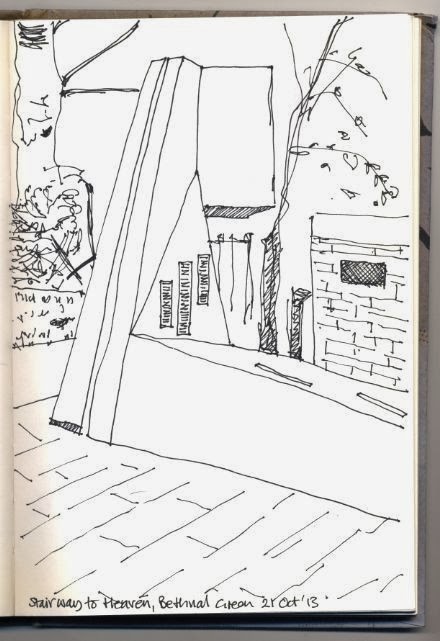
Public art 3: Stairway to heaven

Stairway to heaven memorial, Bethnal Green, designed by local architect Harry Paticas with initial help from Jens Borstelmann
This memorial didn't attract much attention from passers-by who were busy going about their day when I visited it last month. It is sited near a library in a park next to Bethnal Green tube station on the corner of Cambridge Heath Road and Roman Road.

This part of the park had been a cordoned off as a building site for quite some time and I was keen to take a look at it now it is accessible to the public. I had no idea when I arrived how emotionally affected I would feel by the time I left. I also had no idea until I read more about the design of it that it is still incomplete. The trust that runs it need to raise the money for the actual staircase. In spite of this the memorial, as it stands, is an affecting tribute to the people involved in the worst civilian disaster in the UK during WWII.

During WWII it was common for tube stations to be used as communal air raid shelters. They could accommodate thousands of people unlike the cramped, airless shelters buried in back gardens. Londoners had endured relentless bombing during the Blitz in 1940-41 with the city being hit 57 nights in a row. The population got used to air raid sirens going off even though they might be false alarms and would spend the night in the shelters as a precaution.

Bethnal Green station is on the Central Line and was still under construction when this disaster took place on 3 March 1943 as a result of several things happening at once. The siren sounded, a cinema closed and three buses let off their passengers so they could make their way to the shelter. 

A woman carrying a baby tripped and fell as she walked down the steps to the platform. A man tripped over her and a domino effect began. At the top of the stairs came a shouted warning of bombs falling and when a different deafening sound was heard they thought it was a new kind of bomb (it turned out to be a new, secret, anti-aircraft rocket battery being tested in Victoria Park near by).

As a consequence of this it is estimated that around 178 people died that night, many of whom were crushed to death, and a further 60 people were wounded and needed hospital treatment. Many of the survivors never recovered from this experience and the Government of the day decided to hush it up. To me this is reason enough to have a very public memorial where local people can remember their families.*

*I found most of this information at the memorial's website. You can also read individual stories from this disaster at the same site.


This seat is part of the memorial and is where I sat while I drew this sketch


Thursday, 7 November 2013

Public art 2: Reclining figure in bronze

Reclining figure in bronze by Thomas Bayliss Huxley-Jones made in 1964 outside Hornsey library
Monday evening was handing in day for the Islington Art Society's autumn exhibition at the Original Gallery at Hornsey library. While I was approaching the library I noticed this sculpture in a pool with a fountain. I liked the sculpture so much I thought I would show it at two angles.


I love the exuberance on display here and now that I have just begun to be aware of civic sculpture I am impressed that local authorities used to commission art in a way that never happens now.

Tuesday, 15 October 2013

Public art 1: The blind beggar by Elizabeth Frink 1959

This is going to be first post in an occasional series about public art. There is so much art on display in formal squares, on street corners and in gardens in London that I feel the urge to comment on some of it.

I pass this sculpture regularly when I am on the no 8 bus heading down Roman Road. It is a piece of public art in the sense that you can see it from the main road but it is on private property in the gardens of a group of bungalows on the Cranbrook Estate. So unless you can get to know someone who lives there this is as close as you are going to get to it.

I included my wonky video because I enjoy the sound of the fountain playing in the background. I made a quick sketch of it from a nearby bench where I could spread out and while I was drawing I thought that it was merely of a man taking his dog for a walk. But it turns out it represents The Blind Beggar of Bethnal Green who is said to be a local mythological figure dating back to the seventeenth century. This bronze sculpture stands eight feet tall and was created by Elizabeth Frink in 1959 having been commissioned by Bethnal Green Metropolitan Borough.

The blind beggar is also represented at other sites in Bethnal Green and at the pub of the same name in Whitechapel which is notorious for the Kray twins killing of George Cornell in 1966.

I would love it if our borough council chose to site a fabulous piece of sculpture outside our house and perhaps include a fountain but I'm afraid it's never going to happen.