Showing posts with label sketching. Show all posts

Tuesday, 4 October 2016

A visit to Bletchley Park

The tea room in the visitors centre. I thought this was a good visual metaphor for the grids and patterns that the code breakers were looking for
A comfortable 45 minute train ride from London Euston saw us delivered to Bletchley railway station in bright sunshine followed by a short walk to the entrance to the visitors centre at Bletchley Park. What a contrast this must have been to how members of staff used to arrive at work during WWII when Station X (as it was known) was completely secret.

Now Bletchley Park has its own website but it very nearly didn't survive plans in the early 1990s to be demolished and replaced with a housing estate, petrol station and supermarket. Thanks to the dedication of some well-connected enthusiasts and veterans who had worked there the site has been preserved and allows us, the visitors, to get a glimpse of what it was like slogging away on eight hour shifts breaking the Enigma codes that the German Army and Air force were sending day and night.

In hut 11 the display gives you some idea of the constant noise the WRNS (Women's Royal Naval Service) had to endure not to mention the discomfort of standing up for their whole shift. In huts 3 and 6 where the top secret code breaking took place you can see packets of cigarettes at every desk so the staff must have been working in a fug of fag smoke all day long not to mention worrying about getting the job done which reminds me of working in publishing in the early 1980s.

The results achieved at Bletchley Park due to the perseverance of scholars like Gordon Welchman a fellow at Sydney Sussex College, Cambridge who led the Enigma decryption team and mathematicians including Alan Turing, are credited with shortening WWII by two years which is remarkable. Once the war was over Bletchley Park was shut and all the staff returned to their civilians lives having been instructed never to mention to anyone what they did during the war.

Obviously a visit to this previously secret site feels a bit artificial. Civilians would never have been given access to stroll around the offices, loll about in the canteen or lounge around the gardens any more than we would be able to at MI6 or MI5 now but it does give the visitor some idea how complex the business of preserving a nation's security is which is not something I've ever given much thought to.

Quick pencil sketch of the mansion

Tuesday, 19 January 2016

Ice skating at Canary Wharf

Here's my warm-up drawing
I belong to an informal sketching group called Art in the Park and we visited the ice rink at Canary Wharf for our first outing of 2016. This is a temporary structure and we sheltered in the pop-up pub on site called the Tasting Room.

It always takes me a while to settle into drawing so I began with a pencil view of the bar. Then I turned my attention to the outside and the skaters circling the rink. I admired their collective courage - their expertise ranged from terrified novice to fearlessly competent. I quite envied them and briefly considered joining in but decided I was just avoiding trying to sketch the skaters.

First attempt at skaters
Second attempt - thought it was getting a bit repetitive
My fellow artists

Then I thought it might be fun to try drawing without looking at the paper so I tried this with my fellow artists and liked the result. I found it difficult to only look at the subject so compromised by looking at the paper as little as possible. I really liked the way this was going so did one last drawing of a table and chairs using the same approach.

I was happy with the way this drawing turned out and if felt good to take a chance and risk losing control of the final product so while I may not have ventured onto the ice I did step out of my usual drawing 'comfort zone' and reaped some rewards in the process.


Friday, 31 July 2015

Thursday, 23 July 2015

Postcards from Canada: 3

We visited Lakehead University yesterday and while my companions were in a meeting I took the opportunity to sketch this tree. The university is in a rural area and is surrounded by farms and this tree was surrounded by a community garden. Community gardens are flourishing across Canada and in this one they are growing corn, squash and beans following the tradition established by the First Nation farmers.

Postcards from Canada: 1

This is a view of Couchiching Lake from the bottom of our host's garden and my watercolour version of it.

Tuesday, 16 September 2014

Monet: The Thames below Westminster

Taken from the National Gallery's What's On brochure
Yesterday was my birthday and I spent it indulging myself. At lunchtime I visited the hairdressers and then I had intended to visit Lord Frederick Leighton's house in Holland Park. However by the time I had left the salon it was too late in the afternoon to trek over to west London to do the museum justice.

So I walked from the Cut in Waterloo over Hungerford Bridge to the National Gallery because there is always something worth seeing there and last week I had been listening to Front Row on BBC Radio 4 where an interviewee had been raving about an exhibition that was worth visiting. It was only when I was sitting in the Espresso Bar reading the above leaflet that I remembered that the exhibition in question is on at the National Portrait Gallery just around the corner.

I decided that exhibition could wait until another day because by then my eye had spied that in 30 minutes there was going to be a 10 minute talk in Room 44 on Monet: The Thames below Westminster at 4pm. I liked the sound of this so sauntered upstairs to Room 44 and spent about 20 minutes enjoying the Impressionist paintings by Monet, Pissarro and Seurat's Bathers at Asnières which is vast. One of the paintings on display was of a cluttered mantle piece. It was a very ordinary and mundane view but somehow the painting raised it above its very ordinariness.

My sketch of Monet's painting
The Monet painting in question is quite small compared with the others in this gallery. It was painted on a misty day in spring in around 1871. The colours are muted and the shapes indistinct but you can clearly see Westminster Bridge, the boats, the Houses of Parliament and people standing on a jetty in the foreground. I like the way he describes the reflections in the water and how they change in different parts of the river. I should try to do that sometime – I think it's probably more difficult than it looks.

Four o'clock came and went and there was no sign of any one who looked like a speaker. People were milling around though in expectation and then someone said that the bus with the speaker on it had been held up so the talk was cancelled which was a bit disappointing. But I had spend more time than usual inspecting a few paintings and for the first time understood that Monet, Pissarro and Daubigny had all temporarily located to London to avoid the Franco-Prussian war that was raging away in France. So if it hadn't been for the carnage taking place on the Continent we wouldn't have these contemporary impressions of Victorian London.

Tuesday, 10 June 2014

Oh, I do like to be beside the seaside!

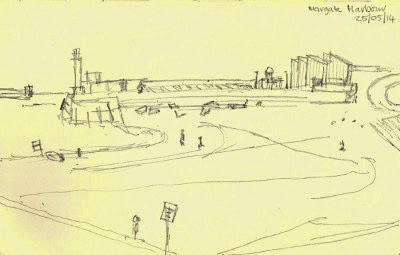
Margate Harbour with the Turner Contemporary - the pointy
building on the right hand side ©Heather James
Margate is notable for several reasons. It became the first seaside resort in England as long ago as the 1730s; it was the first seaside town to introduce donkey rides on the beach around 1780 followed by deckchairs in 1898. It has an ever-changing skyline which is a delight to observe and, unlike Brighton, it has a gloriously sandy beach.

JMW Turner was a frequent visitor to Margate in the 1820s and '30s and the Turner Contemporary Gallery which opened in 2011 (designed by David Chipperfield Architects) is located on the site where Turner used to stay.

The gallery shows a changing programme of exhibitions and the theme being explored now is 'Summer of Colour'. This includes an exhibition of Piet Mondrian's painting ranging from work completed in his twenties right through to his famous 'grid' paintings in red, yellow and blue and visiting this exhibition was our reason for visiting Margate.

As someone who has been a fan of Mondrian since being introduced to his work during an art history lesson aged 16 I was very excited at the prospect of seeing some of his work close up and I was not disappointed. There are about 50 works on show which means there are enough examples of his paintings to see how his work developed towards abstraction through colour but not so many that you feel overwhelmed. I particularly liked 'Dune Landscape, (July-September) '1911 and 'The Red Mill' 1911.

In addition to this there is an exhibition by Spencer Finch, an American artist, who attempts to make visible the fleeting nature of natural phenomena and it includes a suspended sculpture that subtly alters as the natural light in the gallery changes throughout the day. It is worth being patient by staying in the gallery long enough to observe the changing light in order to really appreciate his work.

We stayed in Margate overnight so we had the chance to visit these exhibitions on two consecutive days. In addition to enjoying the gallery we were also able to have a look at Margate train station on our arrival and departure and note that it was designed in 1926 along with Ramsgate Station and was the first major buildings to be designed by the British Modernist architect Maxwell Fry. Apparently the design was based on Roman thermal baths.

Another piece of architecture worth looking at is Arlington House which is close to the station and dominates the skyline. It is a 19 storey residential block designed by Russell Diplock and completed in 1964. It's an iconic example of brutalist architecture and sits slightly uncomfortably with the down-at-heel Victorian seaside architecture surrounding it.

We're looking forward to returning to Margate when the exhibitions change in the autumn, trying out some different restaurants and exploring on foot the Isle of Thanet which is the name for this part of north Kent.

Mondrian and Colour: Turner Contemporary Gallery, Margate until 21 September 2014, free admission


Sunday, 30 March 2014

Mother's Day

It's Mother's Day in the UK on Sunday 30 March and the shops have been full of greetings cards and gifts for the last few weeks. This year it is also the same day that the clocks go forward one hour and we enter British Summer Time.

Instead of buying a card I designed this one for both my mum and my mother-in-law. I decided to recycle an image I made last year as a response to my visit to the Paul Klee exhibition at Tate Modern because I thought it expressed just the right amount of sentiment being both cheerful and unfussy.

Designing my own card reminds me of the time when as a child I used to look forward to the Mothering Day service at church. I didn't much like church services as a rule finding them boring, long winded and the seating uncomfortable – Sunday school was much more fun. But on this one occasion in the year I was prepared to make an exception.

We used to attend St Mary's church in Goats Lane in Basingstoke and someone at the church took the trouble to nurture flowers in the grave yard. On Mothering Sunday they would cut small bunches of primroses and put them in a basket and then us children would be invited up to the altar during the service to collect a bunch to give to our mums' who were sitting waiting in the pew. This would have been back in the 1960s but I still have very fond memories of this annual event.

Friday, 21 March 2014

The day Heather met Heather

Just some of the material promoting all this art in the Medway
Long, long ago (back in the 1970s) I was a student at Bath Academy of Art. This was a small college with around 300 students which was partially housed in old Nissen Huts in the grounds of a Georgian house called Beechfield House. These huts were a legacy from WWII when the RAF was stationed there.

The ceramic studios were in the old coach house, the sculpture school had it's own hanger-like building in the grounds and the cafeteria won an architectural award. The library was housed in a gracious stately home called Corsham Court and many of us lived in charming 18th century workers cottages where the walls were not vertical and nor were the floors quite horizontal. I recall quite a number of students were based at Newton Park (another big house with sprawling grounds) who we never got to meet.

The time I spent there were certainly three formative years – the design principles I learned then still inform my design decisions today – but I do try to avoid viewing my student days there through rose tinted spectacles. It's very easy to recall the gorgeous peacocks strutting around the grounds at Corsham Court and to forget how hard I found the course work.


Rochester Castle from an alley
But, I do remember meeting a very nice student in the etching studio or maybe it was the print shop. This was Heather Haythornthwaite and she was into etching. So on Monday last, 17 March 2014, we finally met again when I paid a visit to her neck of the woods. She's still into etching in a big way and runs the Hazlenut Press out of her house. We had a blast chatting about old times and looking at her black and white photos of fellow students. I chucked out all of my work from college back in the early 80s which I don't regret except that I also threw out a small sketchbook I had made in bookbinding class and never actually drew in it and I was reminded of it while Heather showed me round her house.

Heather gave me a proper tour of some of the artistic charms of Rochester and Chatham starting at Café Maroc and I was staggered at the range of opportunities there are to practice as an artist in the Medway area. It's ironic that I live in Hackney, the London borough that has the most concentration of artists living and working in London, and I'm finding it difficult to get involved in Open Studios and regular exhibitions. Anyway, whingeing aside, Heather and I are looking forward to possibly doing some work together.

Monday, 10 March 2014

I'm in York, the old one not the new one

Looking towards the Minster from King's Square
I'm spending this weekend at the Liberal Democrat spring conference in York. I find listening to politics interesting but also draining so I like to find something cultural to do as well. York was a Roman city and the historic centre of the city is clustered around the rive Ouse with York Minster at it's heart.

The site of the above sketch
I've been here for just over 24 hours and I'm beginning to learn my way around the maze of winding streets that are full of sweet (candy) shops. Two famous Quaker families, Rowntree and Cadbury, established factories in the city in the 19th century making chocolate including some brands like Kit Kat which is still being made today. They employed many people and their staff enjoyed enlightened working conditions which was very unusual for the time.

Apparently York is also full of ghosts. There is the Real Haunted House said to be over 700 years old and full of restless spirits just waiting to put the wind up you. If that isn't enough you can go on any number of competing ghost walks and then visit the York Dungeon to journey through York's murky past. If this doesn't appeal I can recommend a walk around the city walls which provides a great panoramic view of the city.

I didn't do any of these preferring instead to spend a short time soaking up the atmosphere in York Minster which was the most peaceful and tranquil part of my day and where I did the following drawing.

I realised that I would never be able to draw
everything I could see so I just concentrated
on some features


Tuesday, 4 March 2014

My walk home from Springfield Park

View from Springfield Park before the weather
took a turn for the worse ©Heather James

I had plans for yesterday that had to be rearranged on the fly so, after a bit of dithering, I decided to head up to Springfield Park just a few miles away. To save time I travelled by bus. When I set out the weather wasn't too bad but by the time I arrived the rain had settled in which wasn't conducive to the sketching trip I had in mind.

By now it was around lunch time so I went into the café to warm up and delay making a decision to either carry on with my plan or jack it all in and go home. Having eaten I felt fortified enough to explore the park and I spotted a shelter I could stand under so even though it was raining I reckoned it was worth unpacking my rucksack and getting stuck into at least one drawing which you can see above.

I found the view really interesting. It included part of the river Lea, some railway lines, swathes of green and trees coming into blossom. Unfortunately I couldn't explore this view for very long because the rain was driving into my shelter and the far distant horizon had turned from an interesting fuzzy grey with indistinct buildings to a blanket of dark grey with no visible features. There was only one thing for it: it was time to head for home.

Walthamstow marshes
I didn't feel like repeating the crowded bus journey with all the traffic hold-ups and passengers yelling at each other so I chose to walk back along the river. When I set out I realised that it must be five years or more since we had taken this route which I found astonishing. The walk home was about three miles and most of it was either along the river or along the Lea Navigation canal.

I was delighted to experience some sunshine along the way that was so warm I had to remove my hat, gloves and scarf. The sunshine brought out the gorgeous scent of some blossom that looked like Hawthorn flowers but seems rather early in the year since I gather it doesn't usually flower until May. I was less pleased when I had to put all these items of clothing back on and endure more cold, windy rain which increased the closer I got to home.

I was thrilled to watch some of the wild life living on Walthamstow marshes which is one of the last remaining wetlands in London. This is definitely somewhere I'd like to explore later in the year. I enjoyed looking at the maps on my route which look so new I suspect they are a legacy from the 2012 Olympics. I was amazed at the number of blocks of high rise flats that are rapidly replacing old industrial buildings – I can't imagine who will be able to afford to live in them. Most of all I enjoyed the peace and quiet of strolling along the river path and scrutinising the narrow boats moored nearby. Some of them looked so fancy they might be featured in a glossy magazine and some of them looked so dilapidated I hope no-one has to call them home.
It was so tranquil I thought I was in the countryside

Thursday, 27 February 2014

What did the Georgians ever do for us?

Georgian town house built in 1785, Well Street, Hackney
Quite a lot as it turns out as a quick romp around the exhibition devoted to this subject shows. This exhibition marks the 300th anniversary of the accession of King George I in 1714. The Georgian age continued under four successive kings of the House of Hanover until it ended with the death of George IV in 1830.

During this period Britain's prosperity grew as a result of success in continental wars, which led to overseas trade improving which in turn encouraged innovative manufacturing methods and before you know it the industrial revolution was under way and we were on our way to becoming a world power.

The context for the exhibition is set in the first gallery with portraits of the four monarchs looking well fed and rather self-satisfied displayed at regular intervals and interspersed with key dates and descriptions of battles won and laws passed, etc.

Not surprisingly this exhibition concentrates on the positive aspects of Georgian life and pretty much ignores the squalour associated with this period. It's quite obvious from reading Life at Grasmere that begging was commonplace and times were often hard for people. Thomas Coram's Foundling Hospital, which opened in 1741 because so many mothers had no choice but to abandon their children, is only mentioned on the back of the exhibition notes as part of an interesting walking tour of London. Edinburgh, Cheltenham and Bath, all famous Georgian cities do get a mention but most of the attention is on our capital city, London.

Enough of the grumbling. I didn't realise that the urban life I enjoy today has been largely influenced by this period. Public parks that I use regularly were being laid out and a great many of the streets had already been mapped out (the area I live in Hackney was still countryside at this stage). One of the most interesting galleries consists of a blown-up street map of London covering the floor which quite a few visitors, including myself, were engrossed in walking over and scrutinising the road names. It was odd to see Trafalgar Square missing and that's because that great battle hadn't happened then.

So, the Georgians were responsible for creating celebrity culture, the rise of the middle classes who quickly learned to enjoy shopping, furnishing their homes with luxury items and planning their gardens. The fashion industry was born during this period as was the design and advertising industry which I have worked in for several decades. The down side to all this consumerism was that the production of a lot of it depended on slavery which was not abolished until 1807 and in some areas of the world continues to this day.

One of the most enduring legacies of this period was in the design of houses and public buildings. Georgian houses even now command a hefty premium because of their elegance, proportions of their rooms, restrained use of embellishments and the assumptions these make about the owners sophisticated taste and lifestyle. In honour of today's post I went to Well Street earlier and did a sketch of my nearest Georgian town house which used to be a hotel and is now a hostel. For all that it has undergone much remodelling you can still see the typical Georgian features that characterise the architecture of this influential era.

Georgians revealed: Life, style and the making of modern Britain at the British Library until 14 March 2014

Monday, 24 February 2014

Retaining a sense of freedom

Our local garden centre, Growing Concerns, that looks, from
the outside a bit like a prison
I haven't been very well during the last few days so have felt too languid to do anything very much. I have though managed to pick up, and begin to read, a small volume called Life at Grasmere, by Dorothy and William Wordsworth. It's part of a series called English Journeys and is published by Penguin.

It is a combination of journal entries by Dorothy and her brother, William's poetry written while they lived at Dove Cottage in the Lake District. The book opens 14 May 1800. Dorothy would have been 29 years old and William 30. George III was on the throne and England was embroiled in the Napoleonic Wars with the French which led to hard times for many people. Dorothy and William were very attached to each other but it would seem that Dorothy spent much of her time in her own company.

Dorothy occupied herself with household tasks, mending, working in the garden, reading and attending church. She would very often go for walks, helping herself to plants that took her fancy, take them home and plant them in her own garden! You can just imagine how that would go down in our culture – she would be charged with vandalism. For example on 28 May she tells us: "In the morning walked up to the rocks above Jenny Dockeray's, sate a long time upon the grass, the prospect divinely beautiful. ··· I went into her garden and got white and yellow lillies, periwinkle, etc., which I planted."

On 3 June: "Tuesday. I sent off my letter by the Butcher. A boisterous drying day. I worked in the garden before dinner. Read R[ichar]d Second – was not well after dinner and lay down. Mrs Simpson's grandson brought me some gooseberries. I got up and walked with him part of the way home, afterwards went down rambling by the lake side – got Lockety Goldings, strawberries etc., and planted."

Winding rapidly forward to 2014. I recently acquired two new plants. One of them is called Heartsease and the other is Horseradish. I bought them at a garden centre not unlike the one shown above. I am an inexpert gardener but I do enjoy a visit to a garden centre because they are treasure troves of things I do not need, but enjoy looking at, like outdoor furniture that needs more space to show it off than our small garden has. Since these businesses are chock full of valuable commodities they clearly need protecting so it can feel a bit like entering a bank vault. This made me think of other areas in our lives which are also quite constrained.

Of course our population is enormous compared with 200 years ago. It was estimated in 1801 that the population of England and Wales was about 8.9 million while the population of London in 2011 was about 8.1 million. With so many people competing for scarce resources it's no wonder we've ended up keeping to footpaths instead of roaming free, living our lives to strict timetables and conforming socially. It's just easier to do that but once in a while I like to remember that I do have a degree of freedom that I like to express in the art that I make.